During the last year we have been doing some minor research in the world of Fe flow batteries to investigate the use of MgCl2 and CaCl2 water-in-salt (WiSe) electrolytes for all-Fe flow batteries. We have recently obtained a new grant from NLnet to help us better research these chemistries and get to a bigger scale using our larger scale flow cells. The objective of this blog post is to better describe the specific research we will be initially doing and how this will lead to a better understanding of how these flow batteries work.
Our research will use our small scale kits and will be mainly dedicated to the exploration of chemical variations of the all-Fe WiSe chemistries. With this research we would like to answer the following questions:
- Which is the highest CE and more stable WiSe electrolyte, CaCl2 or MgCl2?
- What is the effect of different WiSe electrolyte concentrations?
- What is the highest FeCl2 concentration that can be achieved in these electrolytes?
- Can auxiliary salts like NH4Cl improve the batteries?
- What is the highest stable energy density that we can achieve?
- What are the effects of common minor additives used in Fe flow batteries for improved stability? (citric acid, ascorbic acid, gallium chloride, indium chloride, etc)
Due to the fact that we don’t have the funding or equipment of a large university, we will focus on the more pragmatic aspects of the above questions, that is, we will focus on running the experiments and collecting the battery cycling data (which we will make available for free in our open source website), not so much on answering more complicated “why” questions that would require much more expensive characterizations.
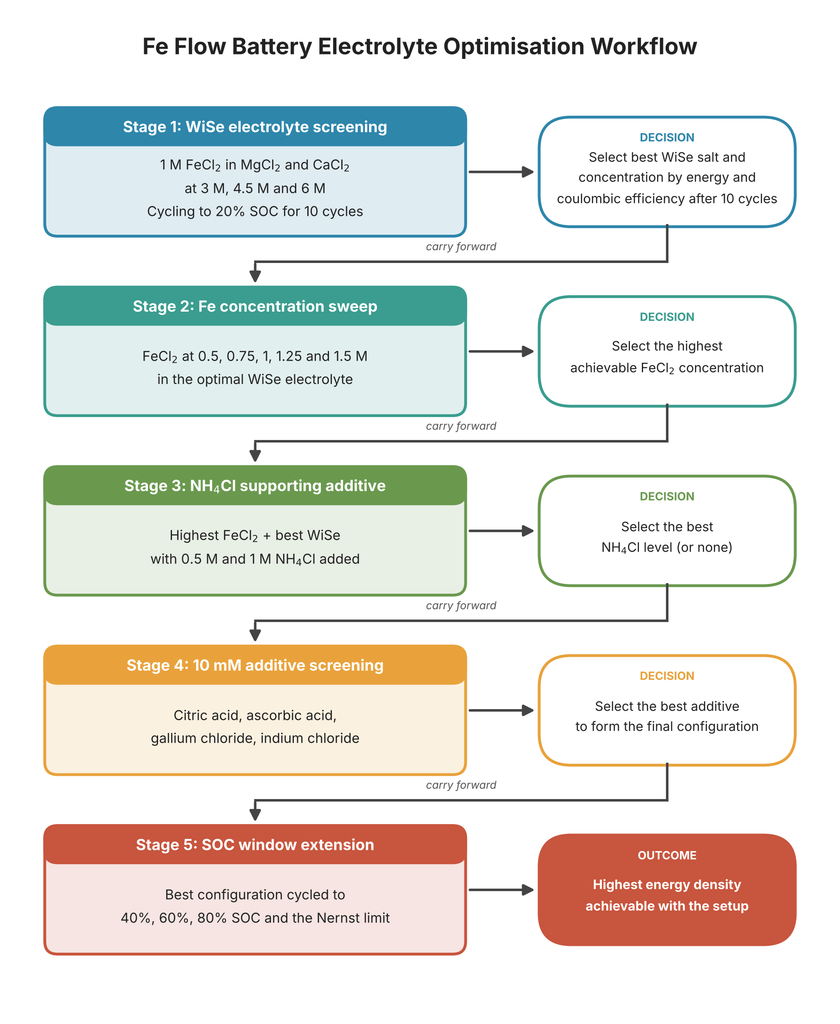
Given the previous experiments we have done and the literature available on Fe plating using WiSe, we will start our experiments with the tests described in the flow chart above. All tests are going to be executed at a current of 10mA/cm2 and all of them will be using 5mm carbon felt that is pretreated with a heating butane torch to improve wetting. All tests will be using a Daramic 900um microporous separator, which has been graciously donated by Daramic for these experiments. All electrolytes will be freshly prepared and filtered using 0.45um PVDF filters before use.
After this we will have a better understanding of how much WiSe can improve Fe flow batteries and whether or not they can achieve stable cycling with limited hydrogen evolution under our testing conditions.
These tests will also build a framework to use for a larger scale flow battery using the all-Fe electrolyte and will inform future experiments we will run. The data for all of these experiments will also become available to anyone who wants to rerun them or analyze the results more closely. The data will be released in chunks as we advance through the different stages of the process.
As always we would like to express our gratitude to NLnet for sponsoring this project!